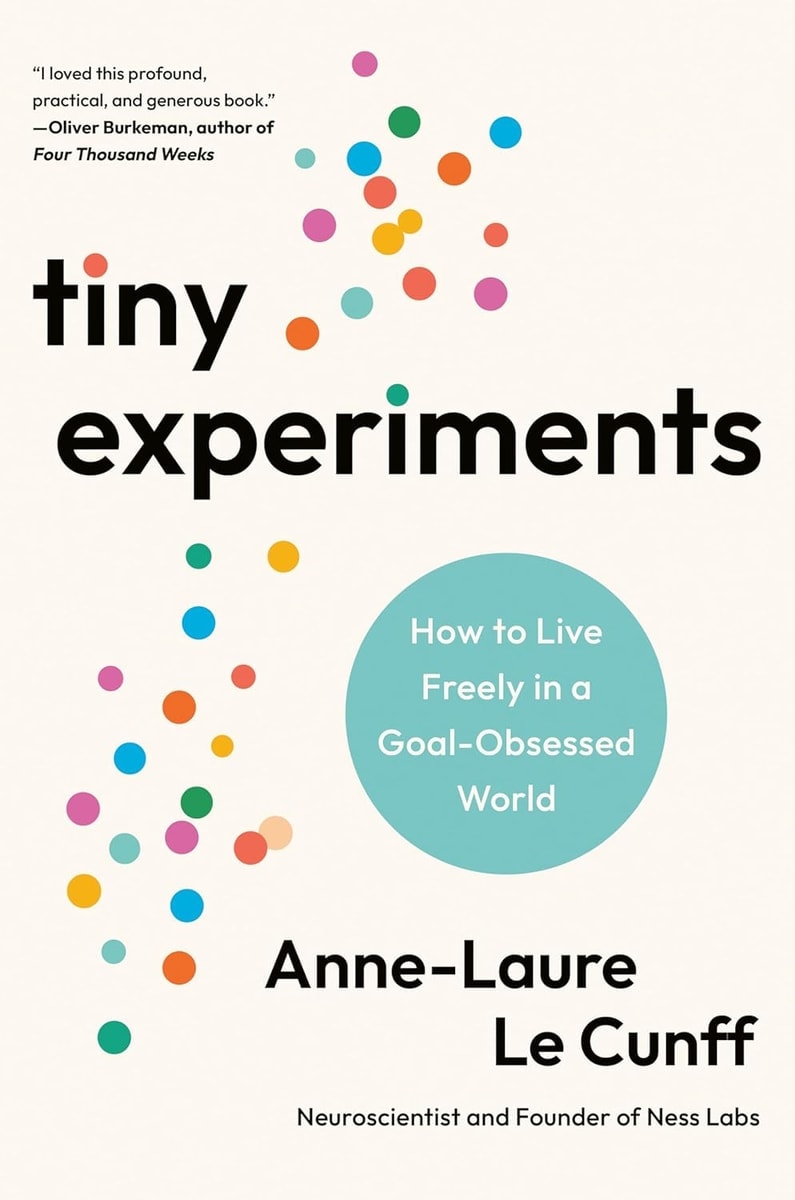
Although the book is not specifically about AI, it feels newly relevant as AI changes how work gets done. The old rhythm of long planning cycles, fixed goals, and carefully tracked execution feels less dominant. More work now happens through rapid implementation, feedback, and revision.
That makes the book's argument for tiny experiments land differently. A pact is not just a personal productivity trick; it is a way to stay oriented when the cost of trying things drops and the future becomes harder to plan. The useful question becomes less "What is the perfect goal?" and more "What can I try next that will teach me something real?"
Highlights
I resisted the urge to clarify my end goal and solely focused on showing up.
The linear way is wildly out of sync with the lives we live today. The challenges we’re facing and the dreams we’re pursuing are increasingly hard to define, measure, and pin to a set schedule.
When the future is uncertain, the neat parameters of rigid goal-setting frameworks are of little help; it feels like throwing darts without a target to aim at.
The flight I have just described is a liminal space—an in-between territory where the old rules governing our choices no longer apply. Life is full of these moments, and the degree to which we learn to reap their lessons is the degree to which we grow and improve our lives.
Psychologists often say that our freedom lies within the gap between stimulus and response.
From outcome to process. When we are operating with an outcome-based definition of success, progress means ticking off big, hairy, audacious goals. When we shift to a process-based definition, progress is driven by incremental experimentation. Success transforms from a fixed target to an unfolding path. Without a fixed definition of success, we welcome change as a source of reinvention. Our direction emerges organically as we systematically examine what captures our attention instead of fixating on an artificial scorecard.
When we fixate on finding one singular purpose, we rule out the side quests that help us grow the most. Your life doesn’t need to follow predictable acts and arcs.
It is reassuring to think that we have a good sense of how things “should” turn out, and it is useful not to be overwhelmed by every new situation so that we can make daily decisions. But these cognitive scripts can also become shackles confining us within artificial boundaries, limiting our perception of what is possible.
Alvin Toffler, the futurist who coined the term information overload in the 1970s, wrote that the illiterate of our times will not be those who cannot read and write, but those who cannot learn, unlearn, and relearn.
The pact is the fundamental building block of personal experimentation, a self-invitation to try something new and learn from the experience.
Compared to linear goals, a pact fosters an experimental mindset—an attitude of openness and curiosity, a willingness to learn with a sense of receptiveness, and a lack of preconceived notions.
Any uncertainty or curiosity can be turned into a pact, from exploring a new hobby to learning a new skill, gauging a potential career path, or trying out a new routine.
As psychologist and philosopher William James explained: “Action seems to follow feeling, but really action and feeling go together; and by regulating the action, which is under the more direct control of the will, we can indirectly regulate the feeling, which is not.”
The format of the pact provides a simple mechanism to commit to action, a way to rely on momentum instead of motivation.
The repeated trials of your pact provide you with more reliable information to make decisions.
In the words of John Maxwell: “The more you do, the more you fail. The more you fail, the more you learn. The more you learn, the better you get.”
A survey of over 31 million activities by the team at Strava found that most New Year’s resolutions are abandoned by January 12, which they called Quitter’s Day.
When I worked at Google, we had OKRs, which stands for Objectives and Key Results. Other companies use KPIs, or Key Performance Indicators. These are all designed to achieve specific targets. Instead of the outcome, a pact focuses on the output. Success is showing up, regardless of the end result.
Whenever you’re procrastinating, ask yourself whether it’s coming from the head, the heart, or the hand: Head: “Is the task appropriate?” Heart: “Is the task exciting?” Hand: “Is the task doable?”
A note of caution: It’s important to notice when we use learning as procrastination in disguise. Sometimes what we think is a lack of skills really is a lack of self-assurance. Reading books or listening to podcasts on the subject won’t help until you apply the knowledge to the task you have been putting off.
Intentional imperfection isn’t about settling for less or not trying your best. Much like the Italians know they can’t make some of the best wine and also make the best corks to close the bottles, intentional imperfection means being deliberate about where you invest your efforts, recognizing that you cannot be at the very top all the time and across all areas of life. It’s about striving for sustainable excellence rather than fleeting perfection.
“Abandon the urge to simplify everything, to look for formulas and easy answers, and begin to think multidimensionally,” said American psychiatrist M. Scott Peck.
Only through combined action and reflection can we achieve meaningful growth: trial and error create a feedback loop of guaranteed learning—a successful cycle of experimentation.
As serial entrepreneur Seth Godin puts it: “Quitting the projects that don’t go anywhere is essential if you want to stick out the right ones.” Every moment you invest in a direction that no longer resonates is a moment you could have invested elsewhere, in a commitment that could offer you more fulfillment.
As long as you’re learning and growing, it doesn’t matter if your route meanders. Your pact should evolve along with you.
The only failure is to confuse mindless movement with mindful momentum. As long as you keep on adapting, learning, and growing, you are winning.
Affective labeling is literally “putting feelings into words.” As you do this, vague anxieties crystallize into a clear set of solid emotions. The pioneer of writing therapy, James W. Pennebaker, explained that labeling our emotions relieves our brains of the burdensome task of processing them. Once you have those words, it’s much easier to investigate their cause and address the issues underlying those feelings.
While individual curiosity can produce incredible feats, our collective curiosity is the motor behind humanity’s biggest innovations. Conversations feed our imagination and collaboration enables us to dream bigger.
...researchers have found that flow states happen more easily in group activities than in solitary ones. Chamber music players are more likely to report being “in the zone” during small group performances than when practicing alone.
When you surround yourself with people who encourage you to experiment and grow, you will unlock new communities of practice and creative territories you couldn’t have discovered on your own. Instead of being the result of solitary thinking, your ideas become woven into a narrative that people want to be a part of.
Across history, many schools of thought converged on this singular truth: none of us can flourish on our own. But our cultural narrative continues to romanticize the lone hero. For example, the story of Einstein’s E = mc² as an isolated breakthrough fails to acknowledge the foundational contributions of scientists such as French mathematician and theoretical physicist Henri Poincaré, who previously discussed the relativity of space and formulated an equation remarkably similar to Einstein’s: the less well known m = E/c². Alongside Poincaré, Dutch physicist Hendrik Lorentz also provided critical theoretical insights that paved the way for Einstein’s breakthrough.
Social flow helps explain why what you know is inseparable from who you know. Instead of feeling like building relationships is the “dirty work” of your otherwise exciting experiments—the grim but necessary self-promotion that distracts you from making progress and honing your craft—you will find that the relationships worth prioritizing won’t distract from your work at all. They’ll improve your work. They’ll support your work. They’ll inspire new work.
When you consistently finish what you start and reflect on the lessons learned, even if the outcome wasn’t what you expected, people see you as someone who takes initiative, follows through, and gleans insights from every experience.
If you manage to free yourself from the hindsight bias, you will realize that you had no idea where each choice would take you and what the journey would feel like. Some of what seem like our most benign decisions can lead to surprising results; some of our most exciting projects can fizzle out.